
Table of Contents
- Why Simple Strength Training for Home Actually Works
- What You Need Before You Start (Almost Nothing)
- Step 1: Build Your Warm-Up Routine
- Step 2: Bodyweight Exercises for Beginners, Your Core Movement List
- Step 3: Structure Your Sessions, How Long Should a Home Workout Be?
- Step 4: Progress Without a Gym Using Progressive Overload
- Safety Tips for Home Exercise and Injury Prevention
- Recovery, Nutrition, and the Psychology of Staying Consistent
Last Updated: August 4, 2026
Simple strength training for home is one of the most practical fitness decisions you can make. According to Australia's Physical Activity and Sedentary Behaviour Guidelines, adults should complete muscle-strengthening activities on at least two days per week, yet many Australians struggle to meet this target without gym access. At MyBetterCore, we provide an encouraging and accessible All In One Bundle, offering simple, effective, and easy-to-follow strategies designed to help anyone transform their daily routine without feeling overwhelmed. Below, we'll show you exactly how to build an effective home training routine from scratch, including warm-ups, core exercises, progression strategies, and the psychological tools that keep you going past week three.
The fundamentals of resistance training, applied consistently, produce genuine gains in muscle mass, bone density, and functional strength. The gap isn't knowledge. It's structure.

Why Simple Strength Training for Home Actually Works
Progressive overload, gradually increasing the demand placed on your muscles over time, drives muscle adaptation. That demand doesn't require a barbell. Bodyweight exercises, performed with correct form and progressively scaled, create the same mechanical stimulus that produces strength gains.
Simple strength training for home works because the barriers to consistency are dramatically lower. No commute. No membership fees. No waiting for equipment. Research from Australian Institute of Health and Welfare physical activity data consistently shows that convenience is one of the strongest predictors of exercise adherence. Complexity is the enemy of consistency. Every layer you add, equipment, programming jargon, elaborate schedules, is another reason to skip a session.
Benefits Beyond the Gym: Bone Density, Metabolic Rate, and Functional Strength
Resistance training increases bone density by stimulating bone-forming cells, particularly relevant for Australians over 40 where bone loss accelerates. It raises your resting metabolic rate as lean muscle tissue increases. It builds functional strength: the capacity to carry groceries, lift children, climb stairs, and recover from physical challenges without injury. Joint health improves as surrounding muscles become stronger and better coordinated. Core stability, developed through planks, glute bridges, and controlled bodyweight movements, supports your spine during everyday activity.

What You Need Before You Start (Almost Nothing)
For a complete beginner programme built around bodyweight exercises, a clear floor space of roughly two metres by two metres is sufficient. A yoga mat adds comfort but isn't essential. If you want to introduce minimal equipment later, a single set of resistance bands costs under $30 and dramatically expands your exercise options.
What matters far more than equipment is a consistent time slot and a written plan. Decide whether you'll train in the morning before work or in the evening after dinner, and protect that time as you would a meeting.
Step 1: Build Your Warm-Up Routine
Skipping the warm-up is the fastest way to turn a productive training session into an injury. A proper warm-up raises muscle temperature, increases joint range of motion, and primes the nervous system for controlled movement. It takes five to eight minutes.
A practical warm-up for home strength training:
- March in place - 60 seconds, lifting knees to hip height
- Arm circles - 30 seconds forward, 30 seconds backward
- Hip circles - 30 seconds each direction
- Bodyweight squats (slow) - 10 reps, focusing on range of motion
- Glute bridges - 10 reps, pausing at the top
- Cat-cow stretches - 8 slow repetitions, breathing deliberately
After your session, spend five minutes with gentle stretching: hamstring stretch, hip flexor stretch, chest opener, and child's pose. This supports recovery and reduces next-day stiffness.
Step 2: Bodyweight Exercises for Beginners, Your Core Movement List
Bodyweight exercises for beginners should cover six fundamental movement patterns: squat, hinge, push, pull, carry, and brace. You don't need dozens of exercises. You need six to eight well-chosen movements performed with correct form.
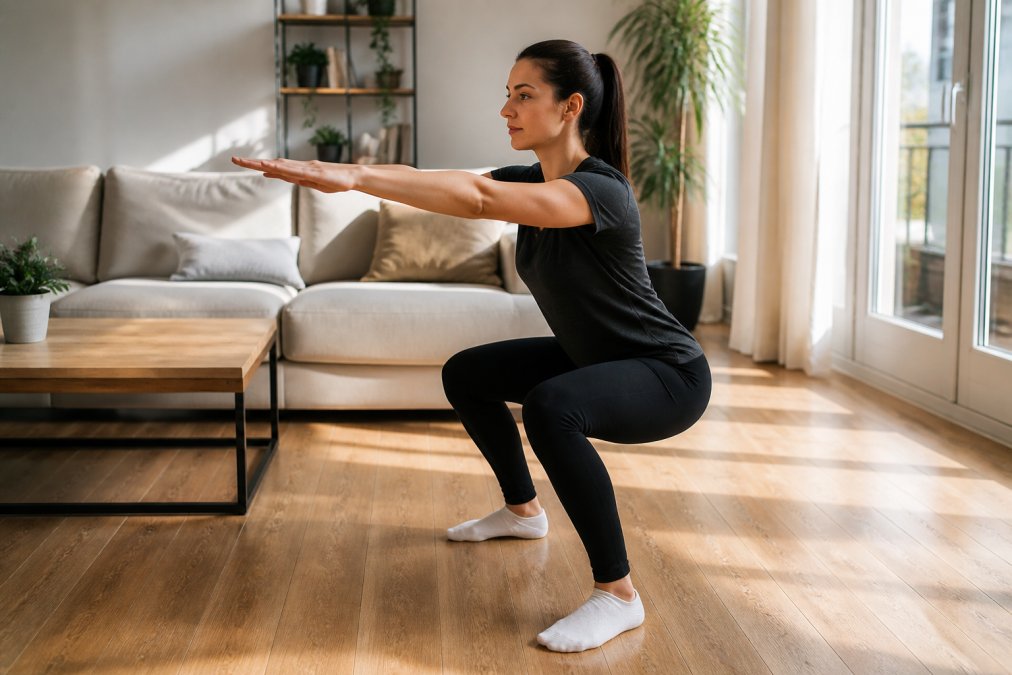
Here is the core movement list for a full-body workout at home:
- Squats - Lower-body strength, quad and glute focus
- Lunges - Single-leg stability and hip strength
- Push-ups - Chest, shoulder, and tricep strength
- Glute bridges - Posterior chain and core stability
- Planks - Core bracing and shoulder stability
- Calf raises - Lower-leg endurance and ankle stability
- Superman hold - Lower back and posterior chain
- Tricep dips (using a chair) - Arm and shoulder strength
How to Perform Each Movement with Correct Form
Squats: Stand with feet shoulder-width apart. Lower your hips back and down as if sitting into a chair. Keep your chest up, knees tracking over your toes, and weight through your heels. Return to standing by driving through the floor.
Push-ups: Start in a high plank with hands slightly wider than shoulder-width. Lower your chest to the floor while keeping your elbows at roughly 45 degrees from your body. Press back up to the start.
Planks: Forearms on the floor, elbows under shoulders. Body forms a straight line from head to heels. Squeeze your glutes and brace your core as if bracing for a punch. Hold for 20-30 seconds to start.
Glute bridges: Lie on your back, knees bent, feet flat. Drive your hips toward the ceiling by squeezing your glutes. Pause at the top for two seconds before lowering.
Modifications for Limited Mobility
- Squats: Perform to a chair. Lower until you touch the seat, then stand.
- Push-ups: Start from your knees, or perform against a wall.
- Planks: Drop to your knees. Keep the straight-line position from knees to head.
- Lunges: Hold a wall or chair back for balance support.
Step 3: Structure Your Sessions, How Long Should a Home Workout Be?
A home workout for beginners should run between 20 and 35 minutes, including warm-up and cool-down. The effective training window, excluding warm-up and cool-down, is 15 to 25 minutes for a beginner. That's enough time to complete three to four exercises across two to three sets each, with adequate rest between sets.
Reps, Sets, and Workout Frequency for Beginners
Reps and sets for beginners:
| Exercise | Sets | Reps | Rest Between Sets |
|---|---|---|---|
| Squats | 2-3 | 10-15 | 45-60 seconds |
| Push-ups | 2-3 | 8-12 | 45-60 seconds |
| Glute bridges | 2-3 | 12-15 | 30-45 seconds |
| Planks | 2-3 | 20-30 sec hold | 30-45 seconds |
| Lunges | 2-3 | 8-10 per leg | 45-60 seconds |
| Calf raises | 2 | 15-20 | 30 seconds |
Workout frequency: For beginners, three sessions per week with at least one rest day between sessions is the standard starting point. This aligns with Australia's physical activity guidelines and gives muscles adequate recovery time.
Step 4: Progress Without a Gym Using Progressive Overload
Progressive overload is the systematic increase of training demand over time. Without it, your body adapts to the current stimulus and stops changing.
Methods for progressive overload at home:
- Increase reps: If you're doing 10 squats comfortably, move to 12, then 15
- Increase sets: Add a third set once the current two feel manageable
- Reduce rest time: Shorter rest periods increase metabolic demand
- Slow the tempo: A four-second lowering phase increases time under tension significantly
- Advance the movement: Move from knee push-ups to full push-ups, or from squats to jump squats
- Add single-leg or single-arm variations: These dramatically increase difficulty without equipment
Tracking Progress at Home (No Equipment Needed)
Record the following after each session in a notebook or phone notes app:
- Date and session duration
- Exercises performed
- Sets and reps completed
- Notes on difficulty (easy, moderate, hard)
After four weeks, compare your records. If you started with 8 push-ups and you're now doing 14 with better form, that is measurable progress.
Safety Tips for Home Exercise and Injury Prevention
Clear your training space of furniture, rugs that slide, and objects at ankle height before every session. Ensure your floor surface provides adequate grip, particularly for lunges and lateral movements.
Exercise form is your primary injury prevention tool. A poorly executed squat with 50 repetitions does more damage than a perfectly executed squat with 15. Prioritise form over volume, always. Recording yourself on your phone and comparing to a reference video is a practical and free solution.
According to Sports Medicine Australia's guidelines on exercise safety, warming up adequately and progressing gradually are the two most effective strategies for preventing exercise-related injury in untrained adults.
Additional safety considerations:
- Hydration: Drink water before, during, and after sessions, particularly in Australian summer conditions
- Footwear: Train in supportive shoes rather than socks on hard floors
- Breathing: Never hold your breath during effort. Exhale on the exertion phase of each rep
- Fatigue: If you feel dizzy, nauseous, or experience chest pain, stop immediately and seek medical advice
Recovery, Nutrition, and the Psychology of Staying Consistent
Recovery is where adaptation actually happens. The training session creates the stimulus; sleep and nutrition deliver the result.
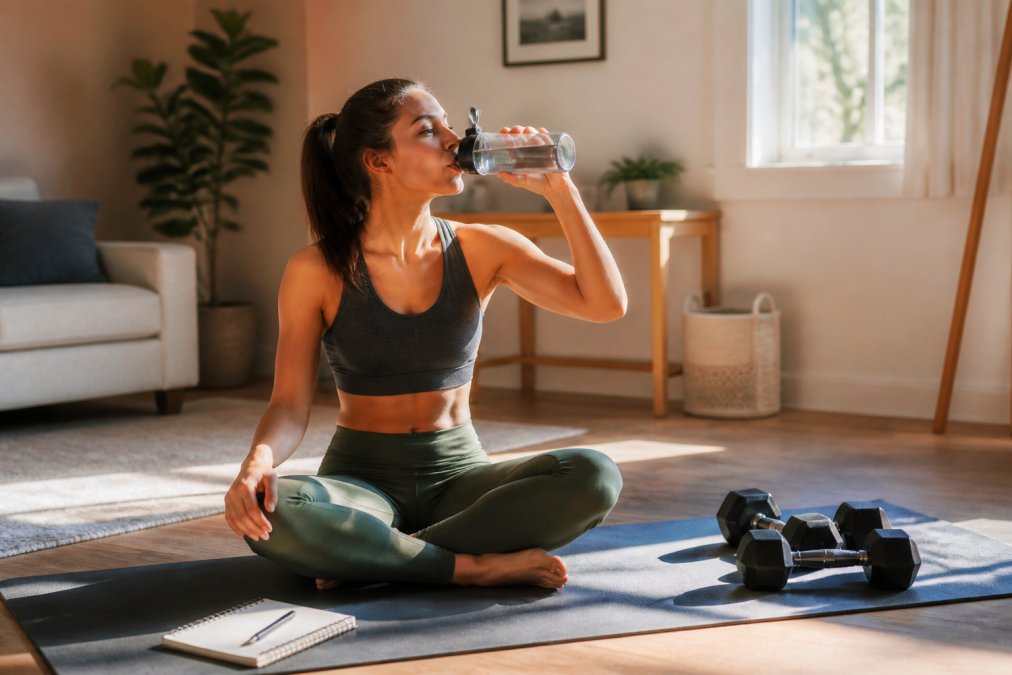
Aim for seven to nine hours of sleep per night. This is a physiological requirement for muscle protein synthesis. Protein intake supports muscle repair and growth. A practical target for active beginners is to include a protein source at each main meal: eggs, legumes, chicken, fish, Greek yoghurt, or tofu are all accessible and affordable options in Australia.
The psychology of staying consistent is the real challenge. Most people who fail at fitness programmes don't fail because the programme was wrong. They fail because of psychological barriers: perfectionism, all-or-nothing thinking, and the belief that a missed session means the whole effort is ruined.
The most effective reframe is this: a two-minute session on a bad day is infinitely better than zero. Doing five push-ups when you're exhausted maintains the habit identity. It tells your brain you are someone who trains.
Two specific psychological strategies that work:
- Implementation intentions: Instead of "I'll work out this week," decide "I will train on Monday, Wednesday, and Friday at 7am in the lounge room." Specificity dramatically increases follow-through.
- Habit stacking: Attach your workout to an existing habit. After morning coffee, before your shower, immediately after the school drop-off. The existing behaviour acts as a trigger.
The MyBetterCore Functional Strength For Longevity: No-Gym Home Workout is built around exactly this principle: a practical, easy-to-follow guide that removes the guesswork and gives you a clear structure to follow, even on the days when motivation is low. At $17.99, it's a structured alternative to piecing together a programme from scattered sources.
For those who want a more complete system covering strength, nutrition, and mental clarity together, the MyBetterCore Mind and Body Wellness Bundle brings three guides into one cohesive system at $49.99.

As documented in Exercise & Sports Science Australia's position on resistance training, consistent resistance training across all adult age groups produces measurable improvements in physical function, mental health outcomes, and long-term independence. Simple strength training for home, done consistently over months, is one of the highest-return health investments available to any Australian adult.
Frequently Asked Questions
What is the easiest way to start simple strength training for home?
Start with four foundational bodyweight exercises: squats, push-ups, glute bridges, and planks. Aim for two to three sessions per week, keeping each session to 20-30 minutes. Focus on controlled movement and correct form before adding reps. You need no equipment to begin. A structured guide like MyBetterCore's Functional Strength For Longevity No-Gym Home Workout ($17.99) gives you a clear, step-by-step plan so you are never guessing what to do next.
Do I need equipment for simple home strength training?
No equipment is required to build real strength at home. Bodyweight exercises including push-ups, lunges, squats, calf raises, and planks cover all major muscle groups and support progressive overload as your fitness level improves. If you want to add variety later, a resistance band (widely available at Australian sports retailers for under $20) is a low-cost option. The best home workout equipment for beginners is simply a clear floor space and a consistent schedule.
How many days a week should a beginner do strength training at home?
Australia's physical activity guidelines recommend adults complete muscle-strengthening activities on at least two days per week. For beginners, two to three sessions per week with a rest day between each allows muscles to recover and adapt. Starting with three days and gradually building consistency is more effective than attempting daily sessions and burning out. Rest days are part of the programme, not a sign of failure.
Are 10-minute home strength workouts effective for beginners?
Yes, provided the exercises are performed with proper form and sufficient effort. A focused 10-minute session using compound movements like squats, push-ups, and glute bridges can build muscle endurance and core stability, particularly for someone new to resistance training. As your fitness improves, extend sessions to 20-30 minutes to continue progressing. Short, consistent workouts done regularly outperform longer sessions done sporadically.
How can I track progress without going to a gym?
Track reps, sets, and exercise variations in a simple notebook or phone note after each session. Record how many push-ups or squats you complete with good form. Over weeks, you will see the numbers climb. You can also note energy levels, how long you hold a plank, or when a movement starts feeling easier. These markers are reliable indicators of strength gains and help you know when to progress to a harder variation.
What should I eat and do on rest days to support home strength training?
On rest days, prioritise protein-rich foods to support muscle repair. Common Australian dietary guidance suggests aiming for protein at most meals, including eggs, legumes, chicken, fish, or dairy. Light activity like walking or stretching keeps blood flowing without taxing recovering muscles. Staying hydrated and getting adequate sleep are the two most underrated recovery tools available. You do not need supplements to see results from a beginner home strength programme.
Building a consistent strength habit at home is genuinely achievable, but it requires a clear structure and a plan for the inevitable hard days. MyBetterCore provides exactly that: simple, effective strategies, easy-to-follow guidance, and a focus on sustainable habits that fit around real life. Explore the Functional Strength For Longevity guide or the Mind and Body Wellness Bundle and get started with MyBetterCore today.
This article was written using GrandRanker