
Table of Contents
- Why a Simple Daily Routine Matters for Busy Professionals
- How to Build Habits When Busy: The Foundation
- Time Management Strategies for Professionals That Actually Work
- Daily Routine Templates for Office Workers
- Overcoming Decision Fatigue and Staying Consistent
- Adapting Your Routine for Remote and Hybrid Work
- Making Your Simple Daily Routine Sustainable
Last Updated: August 18, 2026
Why a Simple Daily Routine Matters for Busy Professionals
A simple daily routine for professionals is the foundation that transforms chaotic schedules into structured, intentional days. Without it, you're left reacting to demands rather than directing your energy toward what matters most.
The challenge isn't finding time, it's reclaiming it. Most professionals feel caught between competing priorities: work deadlines, family commitments, personal health, and the constant pull of digital distractions. When there's no framework in place, decision fatigue sets in early. By mid-morning, you've already made dozens of choices about what to tackle next, and your mental energy is depleted before you've accomplished anything meaningful.

This is where a simple daily routine for professionals changes everything. It removes the friction of deciding what comes next. Instead of waking up and wondering how to fit everything in, you follow a structure that's already been tested and refined. The result: more focus, more energy, and genuine progress on what actually matters.
At MyBetterCore, we've worked with professionals who felt overwhelmed by complex wellness programs. What they discovered is that simplicity isn't laziness, it's strategy. A routine that's too complicated fails within weeks. One that's straightforward and sustainable builds momentum that compounds over months and years.
How to Build Habits When Busy: The Foundation
Building habits when busy requires abandoning the all-or-nothing mentality that derails most people. You don't need a two-hour morning routine or a perfectly optimised workout. You need something small, specific, and repeatable.
The foundation starts with one clear principle: habit stacking. This means attaching a new behaviour to an existing one. You already brush your teeth. You already have coffee. You already sit at your desk. These anchors are where new habits attach. If you want to add five minutes of stretching, do it right after you make your coffee. If you want to build intentionality into your day, do it during your first fifteen minutes at your desk.
Many professionals try to build too many habits at once. This is the fastest route to burnout and quitting. Start with one habit. Make it so small that skipping it feels absurd. Once it's automatic, usually within three to four weeks, add the next one.
The second principle is removing decision points. When you have to decide whether to do something each morning, you've already lost. Your willpower is finite. Instead, make the decision once: this is what happens at this time, every day. No negotiation. No "I'll do it tomorrow instead." This structured schedule eliminates the cognitive load that comes with choice overload.
Research shows that professionals who use time blocking, assigning specific activities to specific time slots, report higher completion rates and less mental fatigue throughout the day. The structure itself becomes the accountability mechanism.
Time Management Strategies for Professionals That Actually Work
Time management isn't about squeezing more into your day. It's about protecting the time that matters and eliminating what doesn't.

The most effective approach combines three strategies: time blocking, task batching, and the workday transition ritual.
Time blocking allocates specific chunks of time to specific types of work. Instead of checking email all day, you check it at 9 AM and 2 PM. Instead of jumping between projects, you dedicate 90 minutes to deep work on one thing. This reduces context-switching, which research suggests can cost professionals up to two hours per day in lost productivity and focus recovery.
Task batching groups similar activities together. Administrative tasks happen in one block. Meetings happen in one block. Creative work happens in a separate block when your cognitive energy is highest. This minimises the mental friction of switching between different types of thinking.

The workday transition ritual is where most professionals fail. They finish work and immediately shift to family or personal tasks without a pause. This creates mental spillover, work stress bleeds into personal time. A five-minute transition ritual changes this. Step outside. Take three deep breaths. Write down what you accomplished and what's next. This signals to your brain that work is complete, which improves both your presence with family and your ability to recover energy for the next day.
Many professionals find that a simple daily routine for professionals incorporating these three elements reduces their sense of overwhelm significantly within the first two weeks.
Daily Routine Templates for Office Workers
A functional daily routine for office workers follows this basic architecture:
Morning anchor (15-30 minutes)
- Wake at a consistent time (consistency matters more than the specific time)
- Hydrate before caffeine
- Five minutes of intentional breathing or movement
- Review your three priority tasks for the day
- This sets the tone for everything that follows
Work blocks (use time blocking)
- 90-minute deep work block (most important task)
- 15-minute break
- 90-minute block on secondary priority
- Lunch break (actually take it away from your desk)
- Afternoon block for collaborative work or meetings
- Final 30 minutes for wrap-up and tomorrow's planning
Evening wind-down (20-30 minutes)
- Clear your desk and close your laptop
- Five-minute transition ritual (mentioned above)
- Prepare tomorrow's clothes and workspace
- Limit screens 30 minutes before bed
- Review what went well today
The specific activities matter less than the structure. Some professionals use this time for exercise, others for meditation, others for reading. What matters is that the structure exists and repeats daily.
Many professionals struggle with consistency because they treat their routine as something to start on Monday or after a holiday. The best approach is to start today, even if it's imperfect. A routine that's 70% executed is infinitely better than a perfect routine that never begins.
Overcoming Decision Fatigue and Staying Consistent
Decision fatigue is the hidden enemy of consistency. By mid-afternoon, your brain has made hundreds of small decisions: what to wear, what to eat, which email to answer first, whether to check Slack. Each decision depletes your mental resources slightly. By evening, you have almost no willpower left.
A simple daily routine for professionals solves this by pre-deciding everything. You don't decide whether to exercise, it's scheduled. You don't decide when to check email, it's blocked. You don't decide what to eat for lunch, you've already planned it. This isn't restrictive; it's liberating. The energy you save on trivial decisions can go toward meaningful work and genuine rest.
Consistency also requires accountability without judgment. Most professionals fail because they miss one day and then quit entirely. They tell themselves, "Well, I've already broken the streak, so what's the point?" This is the consistency trap. The goal isn't perfection; it's getting back on track quickly after a disruption.
Track your routine on a calendar. Put an X for each day you complete it. The visual streak becomes motivating. When you miss a day, you simply mark the next day and continue. No guilt, no restart mentality. Just: today is a new day, and I'm doing this again.
Many professionals find that after three weeks of consistency, the routine becomes automatic. After eight weeks, skipping it feels wrong, your body and mind expect the structure. This is when a simple daily routine for professionals becomes genuinely sustainable.
Adapting Your Routine for Remote and Hybrid Work
Remote and hybrid work blur the boundaries between professional and personal space. Without the natural structure of commuting and an office environment, many professionals struggle with work-life balance and intentionality.
The fix is creating artificial anchors. In an office, the commute signals the start of work. At home, you need to replace that signal. This might be getting dressed in actual clothes (not working in pyjamas), taking a walk around the block, or sitting at a dedicated desk rather than the kitchen table.
The workday transition ritual becomes even more critical in remote work. Without leaving an office, you must consciously signal that work is finished. This might be closing your laptop and moving to a different room, changing clothes, or taking a walk. The specific action matters less than the consistency, your brain learns that this action means work is done.
For hybrid work, the challenge is that your routine changes depending on where you're working. The solution is having a core routine that travels with you. The three priorities, the time blocking, the evening wind-down, these happen whether you're in an office or at home. The location changes; the structure remains.
Many remote and hybrid professionals find that a simple daily routine for professionals actually becomes easier to maintain because they control the entire environment. You can optimise your workspace, eliminate commute time, and create a rhythm that works specifically for you.
Making Your Simple Daily Routine Sustainable
Sustainability is the difference between a routine that lasts two weeks and one that becomes your life. Most routines fail because they're too ambitious or too rigid.
The sustainability formula has three components: small starting point, flexibility built in, and regular review.
Start small. A sustainable routine isn't impressive, it's boring. It's five minutes of movement, not an hour at the gym. It's ten minutes of planning, not a full life audit. It's three priorities, not twelve. This seems too simple, but simplicity is exactly what makes it sustainable. You can do boring consistently. You can't do heroic consistently.
Build flexibility into the non-negotiables. Your three daily priorities are fixed. Your time blocking is fixed. But the specific activities within that structure can shift. If you planned to read but you're exhausted, you can listen to a podcast instead. If you planned to stretch but you have time for a walk, take the walk. The structure stays; the content adapts.
Review your routine every two weeks. What's working? What feels forced? What's missing? A routine that works for you in January might need adjusting in June when your schedule changes. This isn't failure, it's maintenance. The best routines evolve with your life rather than fighting against it.
Many professionals discover that once a simple daily routine for professionals becomes automatic, they stop thinking about it. It just happens. This is the goal. You're not fighting yourself anymore; you're working with your own habits and energy patterns.
The real measure of success isn't how perfectly you execute your routine. It's how much more intentional, energised, and confident you feel. It's noticing that you're finishing work with energy left for your family. It's realising that you're making progress on things that matter. It's the compound effect of small, consistent actions over time.
MyBetterCore's approach to building sustainable habits focuses exactly on this: removing overwhelm through simplicity, creating structure through intentionality, and measuring success by how you feel, not how perfectly you perform. The Life Improvement Bundle combines time management strategies with habit-building guidance specifically designed for professionals who've tried complex programs and found them unsustainable.

Building a simple daily routine for professionals isn't about becoming someone else or completely overhauling your life. It's about creating a framework that works with your reality, not against it. You're busy, that's not going to change. But with the right structure, busy becomes manageable. Chaos becomes clarity. And consistency becomes automatic.
Start today. Pick one anchor habit. Commit to it for three weeks. Then add the next piece. This is how sustainable change actually happens.
| Element | Time Required | Frequency | Best For |
|---|---|---|---|
| Morning anchor | 15-30 minutes | Daily | Setting daily intention |
| Time blocking | 90-minute blocks | Daily | Deep work and focus |
| Workday transition | 5 minutes | Daily | Work-life separation |
| Evening wind-down | 20-30 minutes | Daily | Sleep quality and recovery |
| Weekly review | 15 minutes | Weekly | Routine optimisation |
Frequently Asked Questions
What are some examples of a professional daily routine that doesn't take hours?
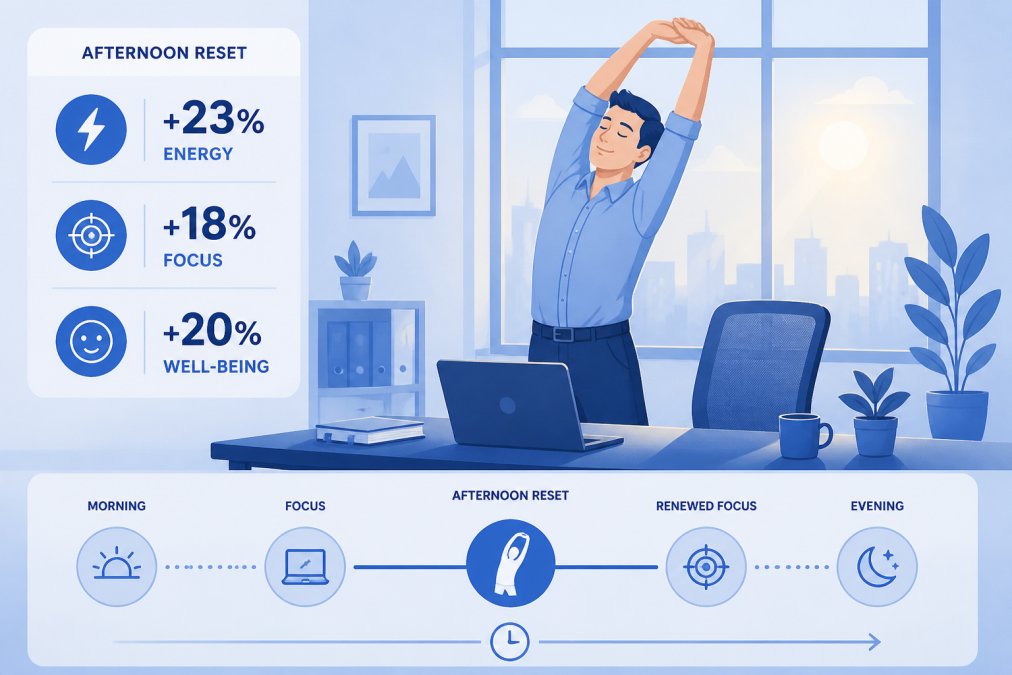
A realistic professional routine spans morning (30 mins: hydration, movement, intention-setting), work blocks (90-minute deep work sessions with breaks), midday reset (10 mins: walk or stretch), and evening wind-down (20 mins: reflection, next-day prep). Most professionals find 2-3 hours total commitment sustainable when spread across the day. The key is consistency, not perfection. Start with one anchor habit, like a 15-minute morning ritual, then add others gradually as that becomes automatic.
How can I build consistent habits when my schedule is unpredictable?
Anchor habits to existing routines rather than fixed times. If your schedule shifts, tie your routine to an action you already do, like after your first coffee or before lunch. Use habit stacking: attach new behaviours to established ones. Track completion, not perfection; even 70% consistency builds momentum. Remote and hybrid workers benefit from a 'workday transition' ritual (5 mins closing your laptop, reviewing tomorrow's priorities) that works regardless of when you finish. Flexibility prevents the all-or-nothing thinking that derails most professionals.
What's the difference between a simple routine and one that's too simplistic to create real change?
A simple routine focuses on high-impact habits, sleep hygiene, movement, intentionality, and task prioritisation, rather than trying to overhaul everything at once. It's simple in design but deliberate in execution. The difference is depth of commitment, not complexity. A 15-minute morning routine with genuine focus beats a 90-minute routine you abandon. Real results come from consistency over months, not intensity over weeks. MyBetterCore's approach centres on sustainable habits that compound; the Mind and Body Wellness Bundle guides you through proven frameworks without overwhelm.
How do I stop losing motivation and falling off my routine like I have before?
Motivation fades; systems prevent failure. Build accountability through tracking (tick off days, log energy levels), anchor routines to existing habits so they require less willpower, and start absurdly small, a 5-minute routine beats a 30-minute one you quit. Identify your specific failure point from past attempts (week three? month two?) and plan a reset ritual for that moment. Many professionals find success with time blocking and energy management: schedule deep work when you're sharpest, admin tasks during energy dips. Resources like Mastering Your Minutes help structure this intentionally.
This article was written using GrandRanker