
Table of Contents
- Understanding Muscular Failure and Training to Failure
- Fitness Consistency Tips for Staying on Track
- Recognising Signs of Exercise Burnout
- Setting Realistic Fitness Goals Australia
- Building a Sustainable Workout Habit
- Overcoming Psychological Fear vs. Physical Failure
- Recovery and Fatigue Management After Intense Training
- Conclusion
Last Updated: August 7, 2026
Understanding Muscular Failure and Training to Failure
Muscular failure occurs when your muscles can no longer produce enough force to complete another repetition with proper form. Training to this point activates the highest threshold motor units, the largest muscle fibres, recruited only when lighter fibres are exhausted. This triggers significant metabolic stress and mechanical tension, two primary drivers of muscle adaptation and hypertrophy.
However, training to momentary muscular failure isn't mandatory for building strength or muscle. Many athletes recommend stopping 2-3 reps before failure, called "reps in reserve" or RIR. This approach reduces fatigue accumulation, preserves recovery capacity, and can be equally effective with consistent progressive overload.
The confusion often stems from conflating training to failure with overtraining syndrome, a chronic underfueling of recovery needs. One is a specific set-ending strategy; the other is a systemic problem developing over weeks of accumulated stress without adequate recovery.
At MyBetterCore, we help clients understand that overcoming failure in fitness routines isn't about pushing harder every session, it's about matching your training intensity to your recovery capacity and long-term consistency.
Fitness Consistency Tips for Staying on Track
The biggest barrier to fitness progress isn't intensity or programming, it's consistency. One missed session becomes two, which becomes a habit break.
Anchor your workouts to an existing daily behaviour. If you shower every morning, place your gym bag by the bathroom. If you have a coffee ritual, schedule your workout immediately after. These habit stacking techniques remove the decision-making step.
Time-blocking is equally critical. Treat your workout like a non-negotiable meeting. Schedule it in your calendar and protect that slot. Morning sessions, even 20-30 minutes before work, create a psychological win that carries through the day.
Track your workouts in a simple log. A note on your phone showing dates and exercises completed creates accountability and reveals patterns.
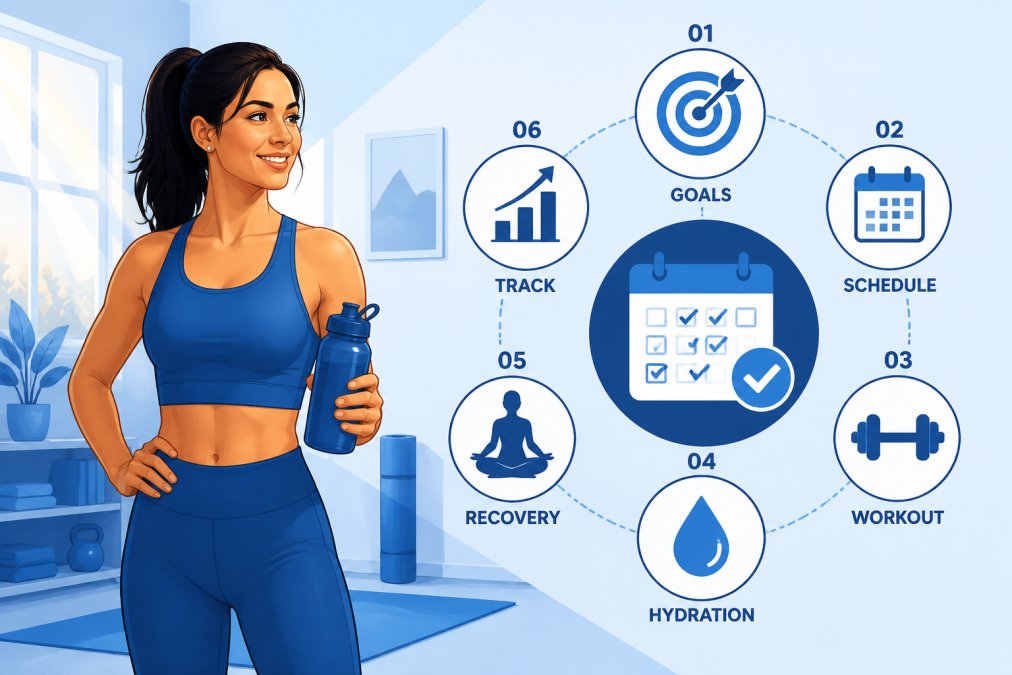
Set a minimum viable workout. On low-motivation days, commit to 15 minutes instead of cancelling entirely. This keeps the habit intact while removing all-or-nothing thinking that derails consistency.
Recovery and fatigue management directly impact your ability to stay consistent. If you're constantly sore, exhausted, or unmotivated, you're likely overtraining relative to your recovery capacity. Many people fail by increasing volume or intensity without increasing sleep, nutrition, or rest days.
Recognising Signs of Exercise Burnout
Exercise burnout differs from normal training fatigue. Normal fatigue resolves within 24-48 hours with adequate sleep and nutrition. Burnout persists across weeks, affecting your performance, mood, and motivation to train.
Early warning signs include persistent elevated resting heart rate, difficulty sleeping despite physical exhaustion, and loss of enjoyment in workouts you previously enjoyed. You might feel heavy during sessions, struggle to hit weights you normally handle, and experience mood changes, irritability, anxiety, or depression disconnected from your life circumstances.
Overtraining syndrome develops when training volume and intensity exceed your recovery capacity over an extended period. Your central nervous system becomes sensitised, immune function declines, and your body enters a catabolic state where muscle breakdown exceeds muscle building.
Performance plateaus are often mistaken for burnout. A plateau means you've stopped progressing; burnout means you're regressing. In a plateau, your lifts stay the same but you feel okay. In burnout, your lifts decline, motivation drops, and recovery becomes difficult even with adequate sleep.
The psychological component is significant. If you dread workouts, feel obligated rather than motivated, or experience anxiety about missing sessions, training has shifted from a positive habit to a stressor.
Setting Realistic Fitness Goals Australia
Goals that ignore your current capacity and lifestyle are guaranteed to fail. Your training experience level fundamentally changes what goals are realistic and how you should approach training intensity.
Assessing your current capacity:
Start by honestly assessing your current training frequency and recovery. If you're working 50+ hours weekly, managing a family, and sleeping 6-7 hours nightly, a goal requiring 6 gym sessions per week is unrealistic. A more honest goal might be 3 sessions weekly with progressive overload on key lifts.
Beginner-specific goal framework (0-12 months of consistent training):
If you're new to structured training, your primary goal should be building movement competency and work capacity, not chasing maximum intensity.
Beginners benefit most from:
- Moderate volume (8-12 sets per muscle group per week) with emphasis on movement quality over load
- Stopping 2-3 reps before failure (RIR 2-3) on most sets to build confidence, reduce injury risk, and accumulate more total volume without burnout
- Consistency over intensity. Three sessions per week for 12 weeks will produce more results than sporadic intense sessions
- Progressive overload through rep increases first. If you can do 8 reps with good form, aim for 9 next week, then 10. Only then increase the weight
- Realistic timelines: Noticeable strength gains appear within 4-6 weeks; visible muscle changes typically require 8-12 weeks
A beginner's goal might be: "Complete 3 strength sessions per week for 12 weeks, adding 1 rep to my main lifts each week, and increase my squat from 60 kg to 75 kg."
Intermediate-specific goal framework (1-3 years of consistent training):
Once you've built movement competency and work capacity, you can tolerate higher volume and intensity.
Intermediate lifters benefit from:
- Higher volume (12-18 sets per muscle group per week) distributed across 3-4 sessions
- Training closer to failure (RIR 1-2 or occasional sets to failure) on compound lifts, while maintaining RIR 2-3 on isolation work
- Periodised programming that cycles intensity and volume: 4 weeks of moderate volume at moderate intensity, followed by 1 week of reduced volume for recovery
- Specific strength goals like "add 10 kg to my bench press in 8 weeks" or "complete 15 unassisted pull-ups by December"
An intermediate goal might be: "Increase my deadlift from 120 kg to 140 kg over 12 weeks using a periodised program, training 4 days per week, while maintaining 7-8 hours of sleep nightly."
Advanced-specific goal framework (3+ years of consistent training):
Advanced lifters have built significant work capacity and can tolerate high volume and intensity.
Advanced lifters benefit from:
- High volume (18-25+ sets per muscle group per week) with sophisticated periodisation
- Training to failure strategically on 1-2 sets per muscle group per session, with the remainder at RIR 1-2
- Autoregulation: adjusting daily intensity based on how you feel using Rate of Perceived Exertion scales
- Specific, measurable targets like rep records or volume targets rather than single-rep maxima
An advanced goal might be: "Achieve 10 reps at 100 kg on the barbell row using a 6-week periodised block, while maintaining bodyweight and sleep quality."
Specific, measurable goals across all levels:
Instead of "get stronger," target "add 5 kg to my squat in 12 weeks" or "complete 10 unassisted pull-ups by October." These goals create clarity about what success looks like.
Time-bound goals with realistic adaptation timelines:
Building noticeable muscle typically requires 8-12 weeks of consistent training. Strength gains usually appear within 4-6 weeks. For returning athletes, your first 4-6 weeks should focus on rebuilding movement patterns and work capacity at moderate intensity, not maximum effort.
Aligning goals with your lifestyle:
Your goal should reflect what you're willing to do consistently. If your lifestyle allows 3 sessions per week, set goals that work within that constraint. The best goal is one you'll actually pursue.
Building a Sustainable Workout Habit
Sustainable habits require three elements: a clear trigger, an achievable action, and an immediate reward. The trigger might be time-based (6 AM) or location-based (arriving at the gym). The action should be simple enough for low-motivation days. The reward can be internal (satisfaction) or external (post-workout coffee).
Progressive overload, gradually increasing training stimulus, is essential for long-term progress without burnout. This means small, consistent increases: one more rep, one additional set, slightly shorter rest periods, or improved movement quality.
Periodisation, varying training intensity and volume across phases, prevents adaptation plateaus and reduces overtraining risk. A simple approach: 4 weeks of moderate volume at moderate intensity, followed by 1 week of reduced volume for recovery.
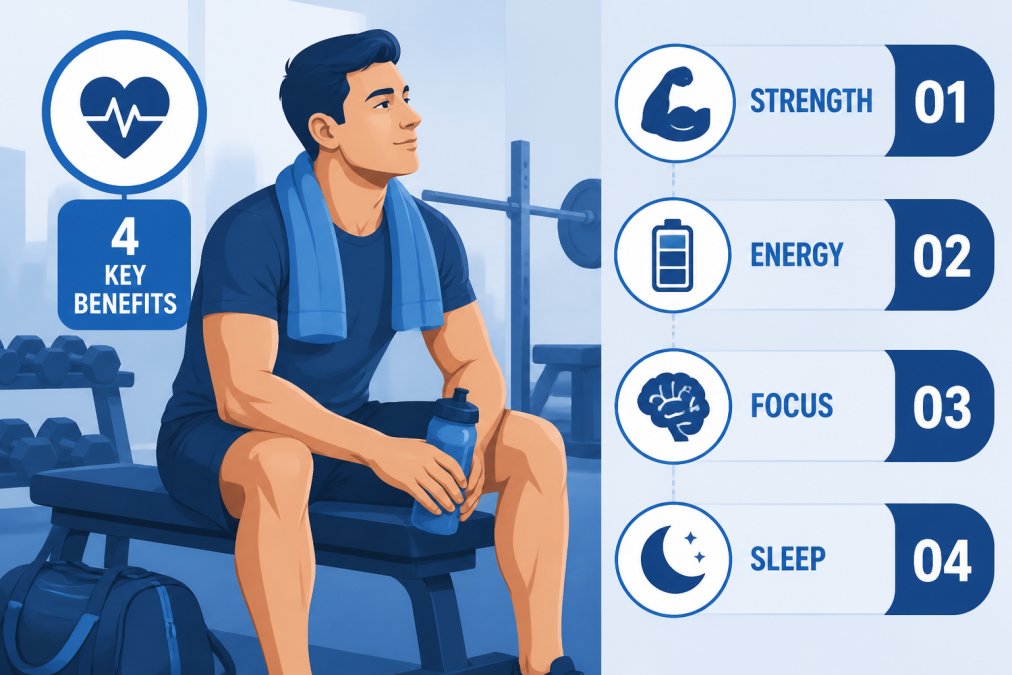
Your workout environment matters more than most realise. Training at home removes travel friction; training at a commercial gym provides equipment variety and social accountability. The best choice is whichever you'll actually use consistently.
Rest days are when adaptation occurs. Your muscles grow during recovery when protein synthesis exceeds protein breakdown. Adequate sleep, nutrition, and stress management during rest days directly determine whether your training stimulus translates into results.
Overcoming Psychological Fear vs. Physical Failure
Many people conflate two distinct experiences: the physical sensation of muscular failure and the psychological fear of failing. Understanding which one is limiting your progress is essential, because the solutions are completely different.
Physical failure is objective and measurable, your muscles cannot produce another repetition with proper form. Your central nervous system has exhausted available motor units, and lactate accumulation, phosphocreatine depletion, and mechanical fatigue have reached their threshold.
Psychological fear of failure is subjective and often prevents you from attempting challenging workouts, trying new exercises, or pushing your training intensity. This fear frequently limits progress more than actual physical capacity.
Diagnosing which barrier is limiting you:
Ask yourself: Can you complete your planned sets with good form, or do you stop early because you're afraid the next rep will be "too hard"? When you do push to discomfort, do you recover normally within 24-48 hours? Do you avoid certain exercises because you fear "failing" in front of others, even though you're capable?
If your answers suggest you're stopping early due to fear rather than genuine fatigue, the barrier is psychological. If you're constantly sore, unmotivated, or struggling to recover, the barrier is physiological.
Reframing failure as information:
Reframing failure as information rather than defeat shifts your psychology. When a set ends at 8 reps instead of your target 10, that's data about your current capacity, not proof that you're weak.
Practically, this means logging not just what you completed, but what you attempted. If you aimed for 10 reps and got 8, that's progress data. Celebrate the attempt, not just the outcome. A session where you gave maximum effort but fell short is a successful session, because effort is what you control.
Progressive exposure to discomfort:
Mental resilience develops through repeated, safe exposure to discomfort. Each time you complete a challenging workout without catastrophic consequences, your nervous system learns that discomfort isn't dangerous.
Start with weights lighter than you think you need. Lifting appropriately, where you can complete most sets with 2-3 reps in reserve, builds momentum and confidence while still driving adaptation. Once you've completed 3-4 weeks of consistent sessions, your nervous system has recalibrated, and you can gradually increase intensity.
The role of social environment:
Psychological fear of failure intensifies in environments where you feel judged. Training alone or with a supportive partner reduces this barrier. Choose the environment that reduces your psychological barrier, not the one that looks impressive on social media.
Recovery and Fatigue Management After Intense Training
Recovery capacity is finite. Your body has a limited ability to process training stimulus, repair damage, and adapt. Exceeding this capacity consistently leads to diminishing returns and burnout.
Sleep is the primary recovery mechanism. During deep sleep, your body releases growth hormone, consolidates neural adaptations, and repairs muscle damage. Seven to nine hours nightly is standard, but your individual need may vary. If you're training intensely, prioritise the higher end.
Nutrition directly impacts recovery. Protein supports muscle repair; carbohydrates replenish glycogen stores; fats support hormone production. Your nutritional strategy should align with your training goals.
Active recovery, light movement on rest days, can enhance blood flow and reduce soreness without adding significant fatigue. Walking, easy cycling, or gentle stretching for 15-20 minutes accelerates recovery.
Manage non-training stress. Psychological stress, work pressure, and poor sleep quality all consume recovery capacity. If your life stress is high, reducing training volume slightly often produces better results than maintaining intensity while stressed.
Deload weeks, periods of reduced training volume and intensity, prevent chronic fatigue accumulation. Every 4-6 weeks, reduce your training volume by 40-50% while maintaining movement quality. This allows your nervous system to recover and often produces a performance jump when you return to normal volume.
Building a sustainable fitness routine means accepting that consistency beats intensity, that recovery matters as much as effort, and that your psychology often limits you before your physiology does. MyBetterCore's Mind and Body Wellness Bundle provides the structured guidance and habit-building framework to help you navigate these challenges without overwhelm. With simple, actionable strategies designed for busy professionals, you'll develop the sustainable habits that deliver real strength, energy, and confidence, not just during your workouts, but throughout your day.

Frequently Asked Questions
How do I know if I'm experiencing actual muscular failure or just fatigue?
Muscular failure occurs when you cannot complete another repetition with proper form, even with maximum effort. True failure means your muscles cannot produce enough force to move the weight. Fatigue, by contrast, is mental tiredness or a general sense of tiredness. You can distinguish between them by attempting one more rep, if your body physically cannot move the weight despite your will to do so, you've reached muscular failure. RPE (Rate of Perceived Exertion) scales help: failure is typically RPE 10, where no additional reps are possible.
What should I do if I keep quitting my fitness routine after a few weeks?
The most common reason people quit is setting unrealistic goals or pushing too hard too fast. Start with just 15-20 minutes three times per week, then gradually increase. Track small wins, consistency matters more than intensity. Use MyBetterCore's Mind and Body Wellness Bundle ($49.99), which includes proven habit-building strategies designed specifically for busy professionals. Focus on making exercise a non-negotiable part of your day, like brushing your teeth, rather than something you 'try to fit in.'
Is training to muscular failure necessary to build muscle and strength?
No. Research shows that training close to failure (leaving 1-3 reps in reserve, or RIR) produces similar hypertrophy and strength gains with less injury risk and faster recovery. Training to absolute failure every set increases overtraining syndrome risk, especially for beginners. A balanced approach uses moderate intensity with progressive overload, gradually increasing weight or volume over time, which is safer and more sustainable for long-term fitness success.
How can I stay motivated and avoid falling off my fitness routine again?
Build accountability through habit stacking: attach your workout to an existing routine (e.g., right after breakfast). Join a community or find a workout partner. Track progress visually, mark off completed workouts on a calendar. Most importantly, focus on how exercise makes you feel (more energy, better sleep, improved confidence) rather than just physical appearance. MyBetterCore's Life Improvement Bundle ($49.99) combines fitness, nutrition, and mindset strategies to keep you accountable across all three areas.
This article was written using GrandRanker