
Table of Contents
- How Much Time for Daily Fitness Actually Matters
- Understanding the Australian Physical Activity Guidelines
- Moderate-Intensity vs. Vigorous Activity: Why Duration Changes
- High-Intensity Interval Training Duration and Time Efficiency
- How to Fit Exercise into a Busy Schedule Without Overwhelm
- Quality Over Quantity: Making Every Minute Count
- Building Consistency and Rest Days into Your Daily Fitness Routine
- Conclusion
Last Updated: August 13, 2026
How Much Time for Daily Fitness Actually Matters
The question "how much time for daily fitness" stops most people before they start. They imagine hour-long gym sessions and rigid routines. The reality is simpler: the right amount depends on your intensity, goals, and what you can sustain. At MyBetterCore, we've found that consistency beats perfection every time. A 20-minute focused session beats a 60-minute half-hearted attempt.
Understanding the Australian Physical Activity Guidelines
The Australian Physical Activity Guidelines recommend specific targets that form the foundation of how much time for daily fitness you should aim for. These targets vary significantly by age group.
For adults aged 18-64, the standard recommendation is 150 minutes of moderate-intensity aerobic activity per week, or 75 minutes of vigorous activity, combined with strength training on two or more days per week.
For older adults aged 65 and over, the guidelines remain 150 minutes of moderate-intensity aerobic activity or 75 minutes of vigorous activity weekly, but with a critical addition: balance and mobility work becomes mandatory. Activities like tai chi or heel-to-toe walking should occur on at least two days per week. An older adult might allocate 120 minutes to aerobic activity, 40 minutes to strength training, and 20 minutes to balance work, a different distribution than younger adults.
For younger adults aged 18-30, the guidelines are numerically the same, but higher recovery capacity means they can compress weekly targets into fewer, more intense sessions if time is limited.
For children and adolescents aged 5-17, the recommendation is 60 minutes of moderate-to-vigorous activity daily, with strength and bone-strengthening activities on at least three days per week, reflecting developing bodies' different physiological needs.
Breaking down the weekly target into daily terms: 150 minutes per week averages to about 30 minutes per day across five days. You could do three 50-minute sessions, five 30-minute sessions, or mix based on your schedule. The flexibility is intentional, designed to make the guidelines achievable for real people with real constraints.
Moderate-Intensity vs. Vigorous Activity: Why Duration Changes
Understanding the difference between moderate-intensity and vigorous activity directly affects how much time for daily fitness you need. These describe different physiological demands, and the intensity you choose changes your time commitment.
Moderate-intensity aerobic exercise means your heart rate increases noticeably, you're breathing faster, and you can still hold a conversation but not sing. Examples include brisk walking, recreational cycling, or light jogging. At this intensity, 150 minutes per week is the target. The advantage is sustainability for longer periods and easier habit maintenance.
Vigorous activity pushes harder. Your heart rate is elevated significantly, breathing is heavy, and you can only speak in short phrases. Running, high-intensity cycling, or competitive sports fall into this category. Because the physiological demand is higher, 75 minutes per week delivers similar cardiovascular benefits. The trade-off is higher injury risk if form breaks down.
Most people find moderate-intensity easier to stick with because it's less intimidating. However, vigorous activity is time-efficient for tight schedules. Choose based on what you'll actually do consistently.
High-Intensity Interval Training Duration and Time Efficiency
High-intensity interval training (HIIT) promises significant results in minimal time. For how much time for daily fitness, HIIT offers a genuine shortcut, but only if you understand what it demands.
HIIT involves alternating between short bursts of maximum-effort activity and recovery periods. A typical session lasts 15-30 minutes total, with work intervals of 20-40 seconds followed by recovery periods of 10-60 seconds. Research supports that HIIT delivers aerobic and anaerobic fitness improvements comparable to longer moderate-intensity sessions.
However, HIIT is demanding. Your body needs genuine recovery between sessions. Most experts recommend HIIT no more than two or three times per week, with at least one rest day between sessions. Daily HIIT risks overtraining, fatigue, and increased injury risk.
For practical purposes, HIIT works best as part of a mixed approach. You might do two HIIT sessions per week (30 minutes total) and one or two moderate-intensity sessions (45-60 minutes total) to meet weekly targets without excessive strain.
How to Fit Exercise into a Busy Schedule Without Overwhelm
The gap between knowing how much time for daily fitness you should spend and actually finding that time is where most people stumble. The solution isn't motivation, it's strategy.
Start by auditing your week honestly. Most people discover they have more time than they think, but it's fragmented. Instead of looking for one 60-minute block, look for three 20-minute blocks. A 20-minute walk before work, a 20-minute strength session at lunch, and a 20-minute activity in the evening add up to 60 minutes without overhauling your schedule.
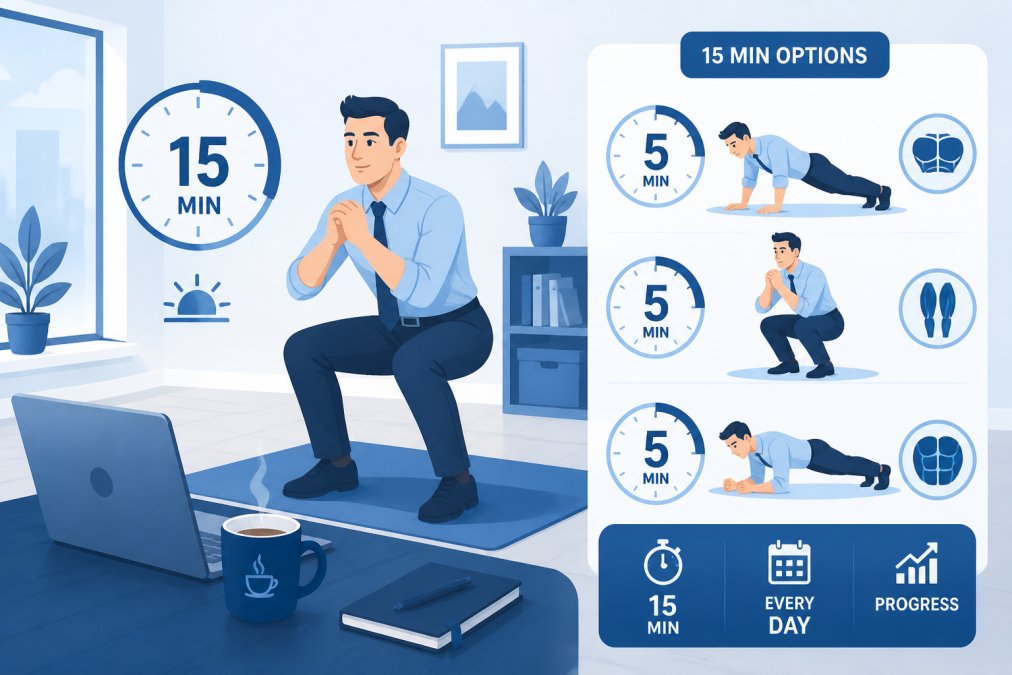
Non-exercise activity thermogenesis (NEAT), energy burned through daily movement like walking to meetings or taking stairs, matters more than most realise. It doesn't count toward formal exercise targets, but it reduces sedentary time and contributes to health outcomes.
Stack fitness into existing routines. Exercise during your commute, lunch breaks, or while watching television. These aren't ideal conditions, but they're realistic, and a suboptimal session you actually do beats a perfect session you skip.
The MyBetterCore approach focuses on building sustainable habits rather than chasing perfect sessions. The Mind and Body Wellness Bundle includes strategies for fitting activity into real life. It addresses the exact objection most people face: "I don't have time."

Quality Over Quantity: Making Every Minute Count
How much time for daily fitness matters less than what you do with that time. A poorly executed 60-minute session delivers fewer results than a focused 30-minute session where every movement has purpose.
Quality means moving with intention. Every rep and stride should have form and purpose. It means progressive challenge, your body adapts quickly, so gradually increase difficulty, reps, weight, or pace. It means matching the activity to your goal: resistance training for strength, aerobic activity for cardiovascular fitness, mobility work for flexibility and balance.
A 30-minute session with clear progression and proper form beats a 90-minute session of unfocused activity. This is why structured programs often deliver better results than casual gym time. Structure enforces quality.
Building Consistency and Rest Days into Your Daily Fitness Routine
How much time for daily fitness is sustainable depends entirely on how you structure rest and recovery. Understanding recovery isn't optional, it's the mechanism that makes training work.
Why recovery matters: Your body doesn't improve during exercise; it improves during recovery. When you train, you create a stimulus. Your body then adapts during rest by rebuilding muscle tissue stronger and replenishing energy stores. Skip rest, and adaptation doesn't happen. Instead, you accumulate fatigue, see decreased performance, and increase injury risk.
Recovery varies by training type: Moderate-intensity aerobic activity requires less recovery than vigorous or high-intensity work. A 30-minute moderate walk might need only 24 hours before the next similar session. A vigorous 40-minute run or 20-minute HIIT session demands 48 hours of recovery. Strength training requires 48-72 hours before training the same muscle group hard again.
Sleep is the primary recovery tool: Most adaptation happens during sleep. Adults need 7-9 hours nightly for optimal recovery. If you're training hard but sleeping only 5-6 hours, you're sabotaging the process.
Active recovery vs. complete rest: Light movement like walking, gentle yoga, or easy cycling on recovery days can accelerate recovery by improving blood flow without creating new training stimulus. A 20-30 minute easy walk on a recovery day is beneficial.
A sustainable weekly structure might look like: three to four days of structured exercise, one to two days of active recovery (light walking, mobility work, yoga), and one to two complete rest days. For example: Monday (strength, upper body), Tuesday (moderate cardio), Wednesday (rest or light walk), Thursday (strength, lower body), Friday (vigorous cardio or HIIT), Saturday (active recovery yoga), Sunday (complete rest).
Why consistency beats intensity: A person who exercises moderately four days per week for a year will see far better results than someone who trains hard for six weeks then quits from burnout. Consistency allows your body to adapt progressively.

MyBetterCore's approach emphasises sustainable habit formation over heroic effort. The Functional Strength For Longevity: No-Gym Home Workout is designed around realistic frequency and duration.

Conclusion
How much time for daily fitness ultimately depends on your intensity, goals, and ability to sustain the habit. The Australian Physical Activity Guidelines provide a clear target: 150 minutes of moderate-intensity activity or 75 minutes of vigorous activity per week, combined with strength training. The real answer is simpler: start with what fits your life, focus on quality over quantity, and build consistency through realistic rest and recovery.
If you're struggling to find a system that works, MyBetterCore's Mind and Body Wellness Bundle offers practical strategies for building sustainable fitness habits without overwhelm. It includes guidance on time-efficient workouts, habit formation, and recovery, the exact tools busy professionals need to maintain strength and energy long-term.
Frequently Asked Questions
Can you get fit with only 20 minutes of exercise a day?
Yes. Twenty minutes of vigorous-intensity activity most days of the week delivers real fitness gains. The key is intensity and consistency. High-intensity interval training (HIIT) or strength training in that timeframe produces measurable improvements in cardiovascular fitness, muscle strength, and metabolic rate. Quality matters more than duration. Many busy professionals see meaningful results with focused 20-minute sessions when they prioritise intensity and stick to the routine.
What are the Australian Physical Activity Guidelines for adults?
The Australian Physical Activity Guidelines recommend adults accumulate 150 minutes of moderate-intensity aerobic activity or 75 minutes of vigorous-intensity activity each week, plus muscle-strengthening activities on 2 or more days per week. This breaks down to roughly 30 minutes on 5 days for moderate intensity, or shorter daily vigorous sessions. The guidelines emphasise that some activity is better than none, and breaking activity into smaller bouts throughout the day counts toward the total.
Does the intensity of a workout change how long it should be?
Absolutely. Vigorous-intensity exercise requires less time to deliver the same aerobic benefits as moderate-intensity activity. Thirty minutes of moderate-intensity walking equals roughly 15 minutes of vigorous running in terms of cardiovascular benefit. High-intensity interval training compresses results into even shorter windows, 10 to 20 minutes of HIIT can match 45 minutes of steady-state cardio. Your fitness goals and current fitness level determine which intensity suits you best.
How long should a beginner workout last?
Beginners should start with 20 to 30 minutes of moderate-intensity activity, 3 to 4 days per week. This builds aerobic fitness and habit formation without causing burnout or injury. Include 2 days of gentle strength training or bodyweight exercises. Rest days are critical, they allow your body to adapt and recover. Consistency matters far more than duration at the start. Many beginners who rush into long sessions quit within weeks; shorter, sustainable routines build lasting habits and prevent overwhelm.
This article was written using GrandRanker