
Table of Contents
- Why Daily Routines Matter for Energy Levels
- 1. Optimise Your Wake-Up Time and Morning Light Exposure
- 2. Prioritise Sleep Hygiene Tips for Better Rest
- 3. Choose Foods That Fight Fatigue at Breakfast
- 4. Move Your Body Early in the Day
- 5. Master Managing Afternoon Energy Slumps
- 6. Build Hydration and Stress Management Into Your Day
- 7. Create a Sustainable Routine with MyBetterCore
Last Updated: August 12, 2026
Why Daily Routines Matter for Energy Levels
Your body operates on circadian rhythms that govern everything from cortisol peaks to melatonin release. When you ignore these rhythms, you're fighting your own physiology. Daily routines to boost energy aren't about willpower, they're about stacking small, deliberate actions that align with how your body actually works.
At MyBetterCore, we've worked with hundreds of people struggling to maintain consistent energy. The pattern is always the same: those who succeed have built routines that work with their biology, not against it.
| Energy Killer | Root Cause | Routine Fix |
|---|---|---|
| Morning grogginess | Skipped light exposure | Get direct sunlight within 30 minutes of waking |
| Mid-morning crash | Blood sugar spike at breakfast | Eat protein and complex carbohydrates together |
| Afternoon slump | Post-lunch blood sugar dip | Move your body for 10 minutes after eating |
| Evening fatigue | No stress management | Add 5 minutes of breathing exercises or mindfulness |
| Poor sleep quality | Blue light before bed | Wear blue-light blocking glasses 2 hours before sleep |
Below are seven habits that move the needle on energy, built on how your nervous system, metabolism, and sleep-wake cycle function.
1. Optimise Your Wake-Up Time and Morning Light Exposure
Your circadian rhythm is a light-sensitive clock. When light hits your eyes in the morning, it triggers a cascade of hormonal changes: cortisol rises, melatonin drops, and your body temperature increases, preparing you for the day.

Most people wake in darkness, check their phone, and hit snooze, further confusing their circadian rhythm. Instead, set a consistent wake-up time and get direct natural light within 30 minutes of waking. A 10-minute walk outside or sitting by a window with coffee is enough. If you live somewhere with limited morning light, a sunrise simulation alarm clock like the Philips Wake-up Light HF3531 can gradually increase light over 20-30 minutes before your alarm. The Philips Wake-up Light HF3531 is available from approximately $233.37 AUD.
Consistency matters more than the specific time. Your body adapts to predictable wake times within about two weeks, and you'll notice you wake more naturally with more stable morning energy.
2. Prioritise Sleep Hygiene Tips for Better Rest
You can't boost energy during the day without proper sleep at night. Your body needs darkness, cool temperature, and a consistent schedule to produce restorative sleep.
The biggest sleep killer is blue light exposure in the evening. Your brain interprets blue light as "daytime," which suppresses melatonin production. Start by dimming lights two hours before bed. If you're a heavy screen user, blue-light blocking glasses like BlockBlueLight Nightfall Taylor Blue Blocking Glasses (from $89.95 AUD) block 100% of blue and green light in the 380-550nm range, the exact wavelength that suppresses melatonin.
A cool bedroom (around 16-18°C) facilitates the 1-2 degree Celsius core temperature drop needed for deep sleep. If you can't control temperature, breathable bedding and light layers help.
Consistency in sleep schedule is non-negotiable. Going to bed and waking at the same time every day trains your body to anticipate sleep and wake times. Aim for 7-9 hours, but consistency matters more than hitting a magic number.
3. Choose Foods That Fight Fatigue at Breakfast
What you eat at breakfast sets your blood sugar trajectory for the entire morning. Refined carbohydrates alone cause blood sugar spikes, insulin release, and crashes 90 minutes later. Instead, combine protein, complex carbohydrates, and healthy fats.
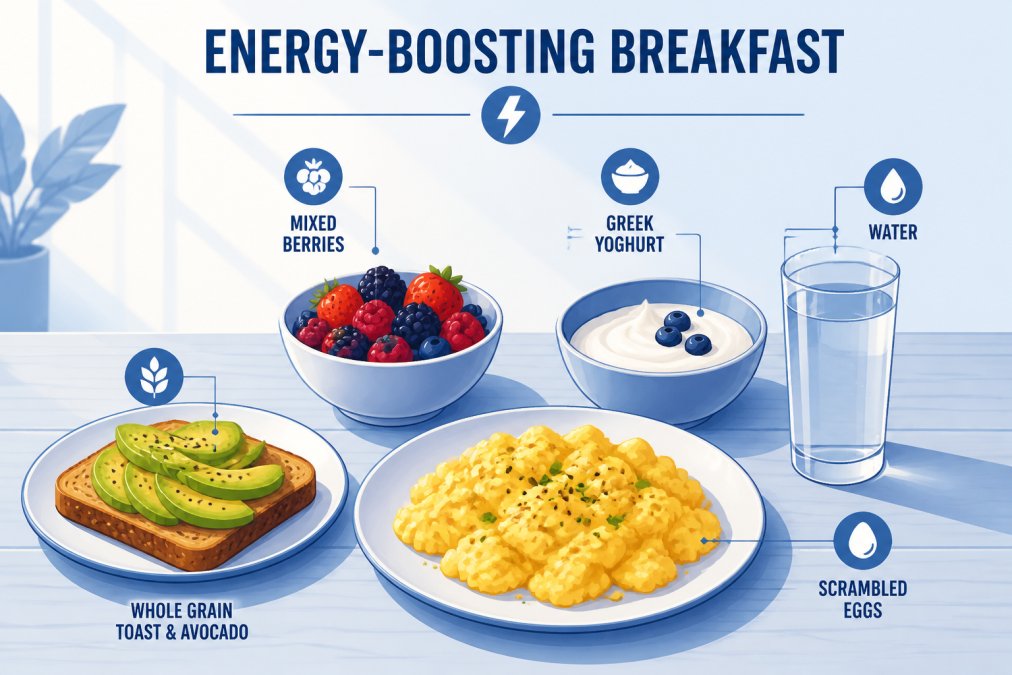
Good options include eggs with whole grain toast and avocado, Greek yoghurt with berries and nuts, or oatmeal with protein powder and almond butter. Aim for at least 20-30 grams of protein at breakfast, the threshold where most people notice improved energy and reduced mid-morning hunger.
If time-constrained, meal delivery services like My Muscle Chef provide high-protein, chef-prepared breakfasts from approximately $7.95 AUD per meal. Hydration matters too: drink a full glass of water immediately after waking, before coffee, since coffee is a diuretic.

4. Move Your Body Early in the Day
Physical activity is one of the most underrated energy boosters. Movement increases blood flow, delivers oxygen to your brain, and triggers endorphins and dopamine, neurochemicals that make you feel alert.
A 10-15 minute walk or light mobility session within an hour of waking amplifies energy from morning light and breakfast. You don't need intense workouts. A walk around the block or basic stretching is enough. Consistency beats intensity: a 15-minute routine you do daily outperforms a 60-minute workout you skip three times a week.

For detailed tracking, a smartwatch like the Garmin Vivoactive 6 provides insights into Body Battery energy levels, heart rate variability, and sleep quality. A 5-10 minute walk after lunch prevents the post-lunch energy slump by stabilising blood sugar and improving digestion.
5. Master Managing Afternoon Energy Slumps
The post-lunch energy crash happens because blood sugar dips after digestion, core body temperature drops slightly, and your circadian rhythm naturally dips in early afternoon.
Most people fight this with coffee or sugar, creating another spike and crash. Instead, use movement and light. A 10-minute walk outside after lunch is more effective than a second coffee. If you can't leave your desk, do 5-10 minutes of stretching or mobility work.
Timing lunch between 12 PM and 1 PM means the post-lunch dip happens around 2-3 PM, manageable with a quick walk. Dehydration worsens the afternoon slump: drink 500ml of water mid-morning and another 500ml mid-afternoon.
For stress management, the Calm App (approximately $79.99 AUD per year for Premium) offers 5-10 minute breathing exercises specifically designed for afternoon energy and focus.
6. Build Hydration and Stress Management Into Your Day
Your brain is 75% water. Even 2% dehydration impairs cognitive function and increases fatigue. Most people wait until thirsty to drink, meaning they're already dehydrated.
Drink 250ml of water with each meal and another 250ml mid-morning and mid-afternoon, totalling about 1.5-2 litres for most adults. The goal is pale urine. If you exercise or live in a hot climate, drink more.
Chronic stress elevates cortisol, impairing sleep and depleting energy reserves. Five minutes of intentional breathing, in for four counts, hold for four, out for four, activates your parasympathetic nervous system and reduces cortisol. Do this once in the morning and once in the evening.
Yoga, tai chi, and stretching combine movement with breath awareness, making them effective for stress reduction. Even 10 minutes daily produces measurable improvements in stress levels and sleep quality within two weeks.
The Dopamine Balance Workbook: Improve Focus & Reduce Digital Distractions ($18.99) addresses digital overwhelm, which dysregulates your nervous system and drains mental energy.

7. Create a Sustainable Routine with MyBetterCore
Most people fail at building sustainable energy routines not because individual habits are hard, but because they try to change everything at once and get overwhelmed. Sustainable change requires starting small, building consistency, then layering in additional habits.
MyBetterCore's Mind and Body Wellness Bundle ($49.99) provides three integrated guides designed to work together: one for sustainable strength habits, one for nutritional clarity, and one for mental clarity. They're intentionally simple and easy-to-follow for real people with real constraints.
Start with one habit from this article. Pick the one that feels most doable, maybe morning light, adding protein to breakfast, or a 10-minute afternoon walk. Do that consistently for two weeks until it's automatic, then add a second habit. This habit stacking approach respects your actual bandwidth and builds on small wins.
Within two months of this progressive approach, you'll have integrated most of these habits without the overwhelm that derails most people. The Life Improvement Bundle ($49.99) expands this framework to include time management and focus strategies, which directly support the consistency required to maintain energy routines.
Energy isn't something you find or chase. It's something you build through deliberate, consistent routines aligned with your biology. When you address circadian misalignment, blood sugar instability, physical inactivity, stress, and poor sleep systematically, energy becomes stable and abundant.
Frequently Asked Questions
What are the quickest daily routines to boost energy levels if I only have 15 minutes?
Focus on three essentials: expose yourself to natural light for 5 minutes (this activates your circadian rhythm), drink a full glass of water with electrolytes, and do 5 minutes of light stretching or movement. These three habits together signal your body to increase alertness and blood sugar stability. Consistency matters more than duration, doing this every morning for two weeks will show measurable improvement in your morning energy.
How do foods that fight fatigue actually work?
Foods that fight fatigue contain protein, complex carbohydrates, and fibre, which prevent blood sugar spikes and crashes. Protein-rich breakfast options like eggs or Greek yoghurt slow digestion and provide sustained energy. Complex carbohydrates (oats, whole grain bread) release glucose gradually, avoiding the energy dip that follows refined sugars. Fibre supports gut microbiome health, which directly influences your energy and mental clarity throughout the day.
Why is sleep hygiene tips so important for daytime energy?
Sleep hygiene, consistent wake times, dark bedrooms, avoiding screens before bed, regulates your melatonin and cortisol levels. Poor sleep hygiene disrupts your circadian rhythm, causing fatigue even if you sleep 8 hours. A consistent sleep schedule trains your body to produce energy hormones at the right time. Most people see energy improvements within 3-5 days of establishing a proper sleep routine, though full circadian adaptation takes 2-3 weeks.
Can managing afternoon energy slumps really be this simple?
Yes. Most afternoon energy slumps happen because of blood sugar crashes from lunch or dehydration. Manage them by: eating a balanced lunch with protein and complex carbs (not just carbs alone), drinking 500ml of water by 2pm, and taking a 5-minute walk in natural light around 2-3pm. This combination resets your cortisol levels and prevents the post-lunch fatigue that derails your afternoon productivity.
The challenge most people face isn't understanding what boosts energy, it's actually building the habits that sustain it. MyBetterCore's bundles are designed specifically for this gap: they provide the structured, guided approach that transforms knowledge into lasting change. Start with the Mind and Body Wellness Bundle and experience how simple, consistent routines can rebuild your energy and confidence every single day.
This article was written using GrandRanker